
Rome / Rome attractions & sightseeing
Things to do in Rome: attractions & landmarks
Top 25 Rome tourist attractions, sightseeing, what to do & highlights
Top 25 Best things to do in Rome Italy, sightseeing and all must-see sites, tourist attractions, hidden gems, famous Roman monuments and historic landmarks. What to do, highlights and best places to visit in Rome?
Things to do in Rome
Day trips from Rome
Map of attractions
Rome is a city full of museums, historic squares, rich food culture, Roman landmarks and other highlights. The Italian city has more places to visit than just the main Rome tourist attractions like the Roman Colosseum, the Pantheon and St. Peter’s Basilica in Vatican City. To prepare your visit to this city, our travel guides shows you the top 25 of the most famous sightseeing, hidden gems and most beautiful Rome attractions. Click one of the must-see highlights, places to visit or Roman landmarks for more information on this unique monuments, museums, tourist attractions and best things to do in Rome Italy:
Best things to do in Rome Italy – Top 25 Rome attractions
1. Visit the Colosseum: Rome’s Top Landmark
The number 1 attraction of Rome is the Colosseum; the large amphitheatre that housed 65,000 spectators in Roman days. Gladiators battled each other as well as wild animals in the Colosseum’s arena, which is considered one of the seven modern wonders of the world. In the giant ‘ruins’ of the Colosseum, you can visit the stands, the arena and the underground spaces of the largest Roman amphitheatre. More info how to visit the famous landmark ‘Colosseum‘.
📌 Warning: Because of the huge number of visitors, it is always necessary to book Colosseum tickets in advance. You have 3 options for tickets: book combi tickets including the Roman Forum, book a Colosseum guided tour and the most popular option is to compare the different Rome City Passes.
2. Throw a coin in the Trevi Fountain
The most famous fountain in the capital of Italy and perhaps even the world must be the ‘Fontana di Trevi’, or Trevi Fountain. This baroque fountain, located on the Piazza di Trevi, was built in the 18th century and a must see at the list of ‘best things to do in Rome’. The landmark and monument displays the god of the sea, Neptune on his chariot. No visit or Rome sightseeing is complete without tossing a coin in the Trevi Fountain, as this means the person throwing the coin will ‘one day return to Rome Italy’.
3. Must see: Pantheon
One of the best maintained buildings from Roman times is the Pantheon. What function the building had in those days is still not clear, but the Pantheon was given to the pope by emperor Hadrian in 608. The current church has several unique funerary monuments (painter Raphael and a few Italian kings), as well as a remarkably large and open dome (oculus). Plan your visit to the Pantheon and explore this architectural masterpiece! Please note: Since a while you need to book tickets for the Pantheon.
4. Visit St. Peter’s Basilica
Best things to do in Vatican City? The St. Peter’s Basilica, or ‘Basilica di San Pietro in Vaticano’ is the spiritual centre of the Catholic Church and residence of the pope. The enormous basilica, located in the independent state of Vatican City and next to St Peter’s Square, was built on what is believed to be the grave of Peter. Saint Peter’s Basilica contains masterpieces such as Bernini’s baldachin and ‘La Pieta’ by Michelangelo, but you can also visit the crypts with 148 papal tombs. Plan your visit to St Peter’s well ahead, or you will likely be standing in line for a long time.
5. Explore the Vatican Museums
Over the centuries, the popes amassed an enormous art collection varying from Roman objects and religious relics to countless paintings. In the Vatican Museum you can visit 54 richly decorated rooms and view these art treasures of the Catholic church. The highlight for many visitors is likely to be the famous Sistine Chapel. The chapel with lovely frescos by Michelangelo that is mostly known as the site of conclave when a new pope is elected. Because it gets so many visitors, this attraction has by far the longest lines.
📌 Important: It’s always important to book your Vatican Museum tickets online, so you can visit the museum at your desired time. During high season, tickets are sold out days in advance (more info about how to book your tickets)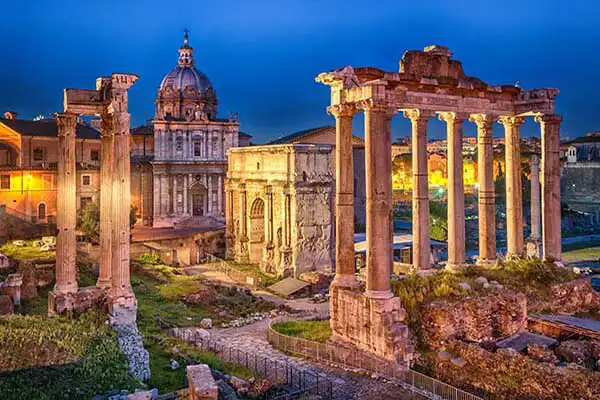
6. Roman sights of Forum Romanum & Palatine
The Forum Romanum was the centre of the ancient Roman Empire. During your visit to the Forum Romanum, you will walk past Roman excavations and the archaeological park full of old temples, arches, market halls and other important buildings built there by different emperors. Next to the forum lies Palatine Hill, where you will find excavations of imperial residences. More info ‘Roman Forum‘
📌 Recommended: The best way to visit the Roman Forum is with a guided tour, so you can better understand the history of the archaeological excavations. Most tours will combine a visit with the Colosseum and Palatine Hill (view the options for guided tours).
7. Famous places: Piazza Navona
One of the most remarkable squares and best places to visit in Rome is Piazza Navona. The famous square therefore owes its elongated shape to its original purpose as a Roman athletics stadium. Interesting sights on the square include a number of fountains, such as the ‘La Fontana dei Quattro Fiumi’ by Bernini, an interesting obelisk, and you can visit the excavations of the old stadium of Domitianus. In addition, Piazza Navona is a lively square with many street performers, cafés and terraces.
8. Castel Sant’Angelo
Originally, the 2nd-century Castel Sant’Angelo, or Castle of the Holy Angel, was a mausoleum for emperor Hadrian. After archangel Michael appeared here in 590 and ended a plague, pope Pius II had a large bronze statue of the angels placed on top of the castle. The Castle of the Holy Angel was part of Rome’s defences and offered a place where popes could shelter, as the Vatican was connected to it by a tunnel. It is recommended to book your tickets online to visit Castel Sant’Angelo.
Rome sightseeing, activities & landmarks
9. Galleria & Villa Borghese
The name ‘Villa Borghese’ refers to the largest and most beautiful park in Rome. At one time, this estate belonged to the very wealthy cardinal Scipione Borghese, and was built around the villa of the same name. Since 1903, it has been in the possession of the municipality of Rome and serves as a public park. The ‘Galleria Borghese’ can also be found in the park, a museum displaying the large private art collection of Borghese. The gallery contains sculptures and paintings by artists such as Caravaggio, Rubens, Bernini and Da Vinci. Important: The museum sells out quickly, so it is really necessary to book tickets in advance.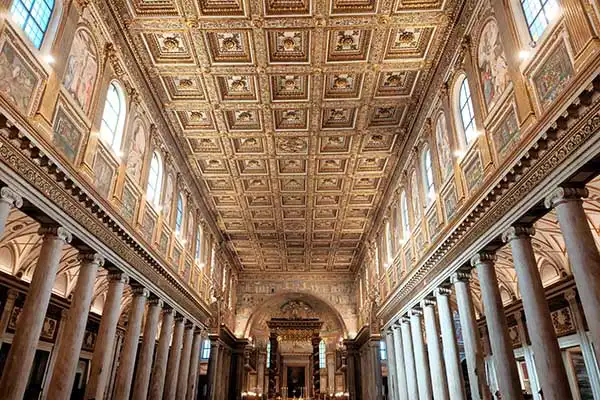
10. Basilica di Santa Maria Maggiore
The Basilica Papale di Santa Maria Maggiore is one of the four papal churches and the largest Marian church in Rome Italy. The church on the Esquiline hill is from the 5th century and still contains many authentic mosaics. It also has a distinctive golden ceiling. It is said that there are even pieces of wood from the crib of Jesus under the altar.
11. Sights of Trastevere
On the opposite bank of the river Tiber lies the old working-class neighbourhood of Rome. Trastevere is a typical Italian neighbourhood where you can get lost in a maze of narrow streets, see old medieval houses, and go for a lively night out in the area’s many restaurants and bars. What to do in Trastevere?
📌 For foodies: A special way to discover Rome and especially the Trastevere neighbourhood is on this Trastevere street food tour, where you will visit Trastevere via various culinary stops.
12. Spanish Steps – Rome’s Famous Staircase
At the foot of the French church ‘Trinita dei Monti’ lie the 135 steps of the Spanish Steps. The Spanish Steps decent to the Piazza di Spagna, where you will find a distinctive fountain by Pietro Bernini. The 18th-century Spanish Steps have grown into a tourist hotspot, and the top of the stairs offers a gorgeous view of Rome.
Best deal: Rome City Pass
Warning: Unfortunately, a number of attractions in Rome are so popular that you must purchase tickets well in advance to ensure you can visit them (in high season sometimes several weeks in advance!). These are the two main highlights: the Colosseum and the Vatican Museums. You can buy individual Colosseum tickets or Vatican Museum tickets, but with the popular Rome Tourist Card or the Rome City Turbopass you will get all important tickets in one purchase (in this article you can compare all Rome tourist cards).
13. Landmarks: Monument of Vittorio Emanuele II
One of the most remarkable of Rome landmarks, the monument of the first Italian king Vittorio Emanuelle II, is located next to the Piazza Venezia square. The building is also called the ‘Altare della Patria’ – the altar of the fatherland – and commemorates the unification of Italy. Romans also use nicknames for it such as ‘typewriter’ and ‘wedding cake’. The colossal white building also contains a museum and the tomb of the unknown soldier, which is guarded by two soldiers.
14. San Giovanni in Laterano
The remarkable thing about the archbasilica of St John Lateran is that the ‘San Giovanni in Laterano’ technically has the status of most important church of Rome Italy. It is one of the four papal basilicas and the cathedral of the Roman diocese. The baroque-looking church has been modified many times over the century, including the addition of the distinctive façade with statues by Alessandro Galilei.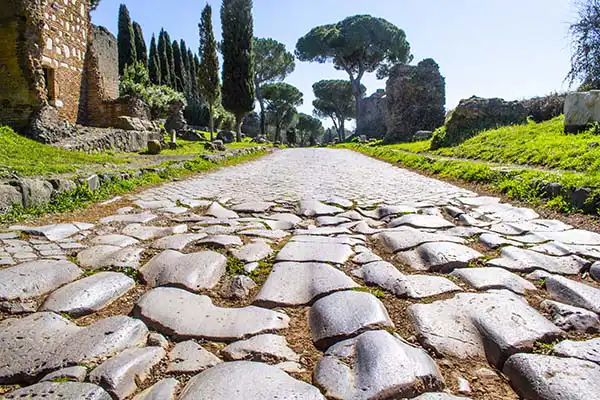
15. See the Via Appia and Catacombs
Via Appia Antica (or Roman Appian Way) is one of the oldest roads into Rome from Roman times. The road with its large cables and lined with many cypresses was originally intended for trade and moving military troops more quickly. The Via Appia road was located just outside the city walls, which meant there were many funerary monuments and catacombs on the side of it, like the Catacombs of San Callisto.
📌 Personal favorite: The best way to visit the Via Appia and its tourist attractions is with this guided bike tour.
16. Piazza del Popolo – Iconic Square
The Piazza del Popolo is a large neo-classical square from the 19th century, originally intended to welcome visitors who entered the city from the north. Noteworthy sights on the square are the two identical churches built across from each other, the city gate ‘Porta del Popolo’, an enormous Egyptian obelisk and the steps that let you climb Pincio Hill for a wonderful view.
17. Hidden gems: Domus Aurea
Domus Aurea are the excavations of Nero’s “Golden House”. Since 2014 it is possible to visit the remains of this huge palace in a very nice way; when you book this guided tour you can experience what the huge palace must have looked like at the time. The tour is only available at weekends, as restoration work is underway for the rest of the week. A lesser-known Rome tourist attraction, but one of my personal favorite hidden gems. Reservation is necessary (more Domus Aurea).
18. Things to do: Rome sightseeing by bike
An easy way to discover much of the Rome landmarks is by bicycle. Rent a bike yourself, or even better, join this guided bike tour (or this E-bike tour) with an English-speaking guide to explore the landmarks and sights of Rome. In a few hours you will see many highlights and you will hear interesting stories about the history of the Roman landmarks. Highly recommended! The tours are very popular, so we recommend that you book in advance (more info & bike tour bookings).
19. Palazzo Colonna or Palazzo Doria Pamphilj
In Rome there are a number of beautiful city palaces from the 16th and 17th centuries. These palaces are all splendor with overwhelming private collections of paintings and frescoes. During your city trip, it is worth visiting at least one palace and its associated galleries. I prefer two palaces; if you are in Rome on a Saturday morning I recommend you the Colonna Gallery, on other days you can visit the Doria Pamphilj Gallery.
20. Basilica di San Clemente
The basilica, dedicated to pope Clement I, is not one of the most impressive churches of Roma at a first glance of its interior. What makes this Basilica of San Clemente special is that multiple church buildings were built on top of each other over the centuries. During your visit, you will have the opportunity to get to know the history of the church through excavations of a 4th-century church, a secret church from the 1st century and Roman foundations.
21. Weird places to see in Rome: Capuchin crypt
A very bizarre place to visit in Rome is the Capuchin crypt. In five chapels under the “Santa Maria della Concezione dei Cappuccini” church, the bones and skulls of nearly 3,600 Capuchin brothers have been incorporated as works of art in the crypts. In the museum you will learn more about the Capuchin Brothers, after which you will visit these very special crypts.
22. What to do: Domus Romane
Below Palazzo Valentini, next to the Forum of Trajan, are the remains of some Roman houses and baths. After a few days in the capital of Italy, you are probably tired of all the stones and archaeological excavations, which is why Domus Romane is highly recommended. The excavations are brought to life with the help of a tour with visual animations and effects. Last visit to Rome, this was my positive surprise. It is recommended to book because of the small groups allowed (more Domus Romane).
23. Discover more churches
Roma counts as much as 900 churches. Be sure to spontaneously step into a church during your Rome visit; even the least famous churches are often beautiful. This article gives you more details about 15 of the most special churches.
24. Baths of Caracalla – Ancient Ruins
The ‘Terme di Caracalla’ are the ruins of the immense bathhouse (baths) from the 3rd century CE. At one time, it was the largest bath complex of Rome with a capacity of 2,500 visitors. Unfortunately, earthquakes and plundering of building materials have left their marks. However, the archaeological digs give a good impression of how truly huge the baths of emperor Caracalla were in those days.